

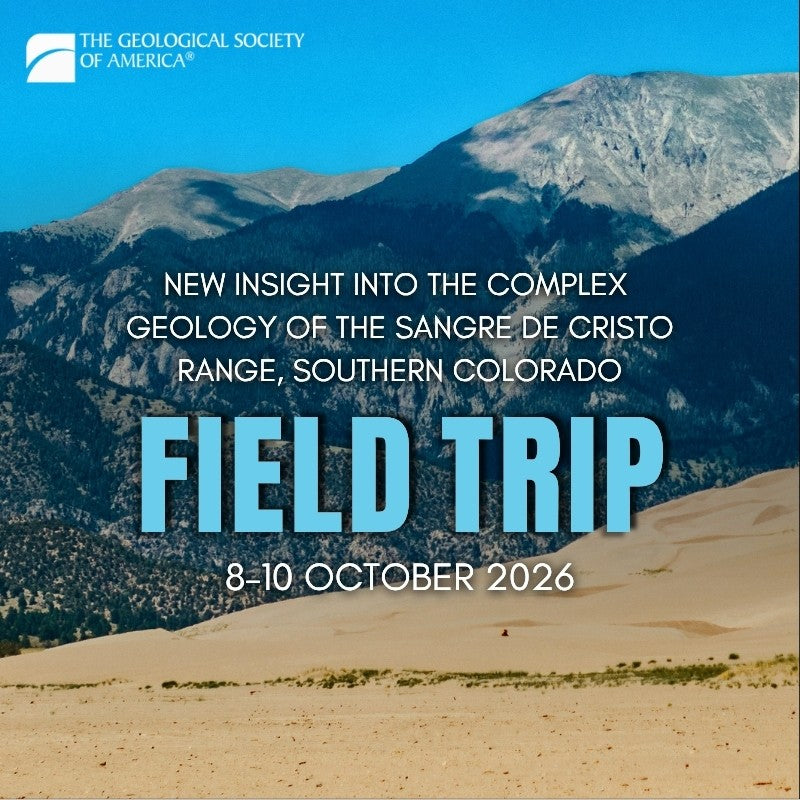
Full Title: FT26CN402. Warren Hamilton: New Insights into the Ancestral Rocky Mountain and Laramide Orogenies, Oligocene Magmatism and Metamorphism, and Rio Grande Rift Extension Along the Western Flank of the Sangre de Cristo Range, Southern Colorado
Price: US$459 for non-members; US$380 for professional members; US$230 for student members; US$320 for early career professional members
Leader(s): John Singleton; Samantha Malavarca; Michelle Gevedon
CEUs: 2.4
Date(s): Thu.–Sat., 8–10 Oct. 2026
Departing Location: Colorado Convention Center, Denver, Colorado, USA
Start Time (first day): 7 a.m.
End Time (last day): 5 p.m.
Description: This three-day, two-night field trip explores the complex geologic history of the Sangre de Cristo Range near Great Sand Dunes National Park and Crestone, Colorado, focusing on new research that provides significant insight into several aspects of the tectonic evolution of the region.
The Sangre de Cristo Range exposes some of the deepest Cenozoic structural levels in the Rocky Mountain region and is a key locality for understanding how different orogenic events and geologic structures relate to each other. Field trip stops will involve short (<0.5 mile) to moderate-length (~3 miles) hikes to visit outcrops related to the Pennsylvanian–Permian Ancestral Rocky Mountains, the Late Cretaceous–early Paleogene Laramide orogeny, Oligocene intrusive magmatism and contact metamorphism, and Rio Grande Rift extension.
Some field trip highlights include spectacular exposures of brittle-plastic deformation along the Mosca Creek thrust and evidence for an early Oligocene pulse of ENE-directed shortening; examples of the likely highest-grade metamorphism of Phanerozoic strata in the Rocky Mountain region; mylonitic fabrics recording thrust- and normal-sense shear along the Independence Mine shear zone; Quaternary fault scarps up to ~10 m high; and the tallest sand dunes in North America.
Discussion topics will include structural reactivation and the relation between contractional and extensional structures, the transition between Laramide shortening and Rio Grande Rift extension, the relation between Oligocene magmatism and deformation, and the impact of deglaciation on late Pleistocene to Holocene fault slip. Participants will stay in dormitory-style lodging at Colorado College’s Baca Campus near Crestone, where evening presentations and discussions will be held. Petrographic microscopes will also be available to view thin sections related to field trip stops.
Considerations: Participants will need to provide their own linens or sleeping bags. Please let us know if you need assistance with any gear. Be prepared for the possibility of cold weather and snow.
Cost includes lodging, ground transportation, and all meals. The Warren Hamilton Field Trip funds support student registrations for the trip. Please follow the link below to apply.
By purchasing this item, you are buying a seat for an in-person geological field trip. This field trip is in conjunction with GSA Connects 2026. Learn more here.
For member-type discounts, please contact fieldtrip@geosociety.org.
Students and Early Career Professionals can apply for funding here.
Field Trips offer Continuing Education Units (CEUs). One CEU equals 10 hours of participation in an organized continuing education experience under responsible sponsorship, capable direction, and qualified instruction.
Please review these Field Safety Documents. You will be contacted to provide your consent to these forms after purchasing a field trip.
● Field Safety Policy & Procedures
For additional information, please contact fieldtrip@geosociety.org.
Product Code: FT26CN402
Product Category: FTRIP
- Choosing a selection results in a full page refresh.
- Opens in a new window.